



NEWS / MODULAR VERTICAL SORTER MVS
Modular Vertical Sorter MVS
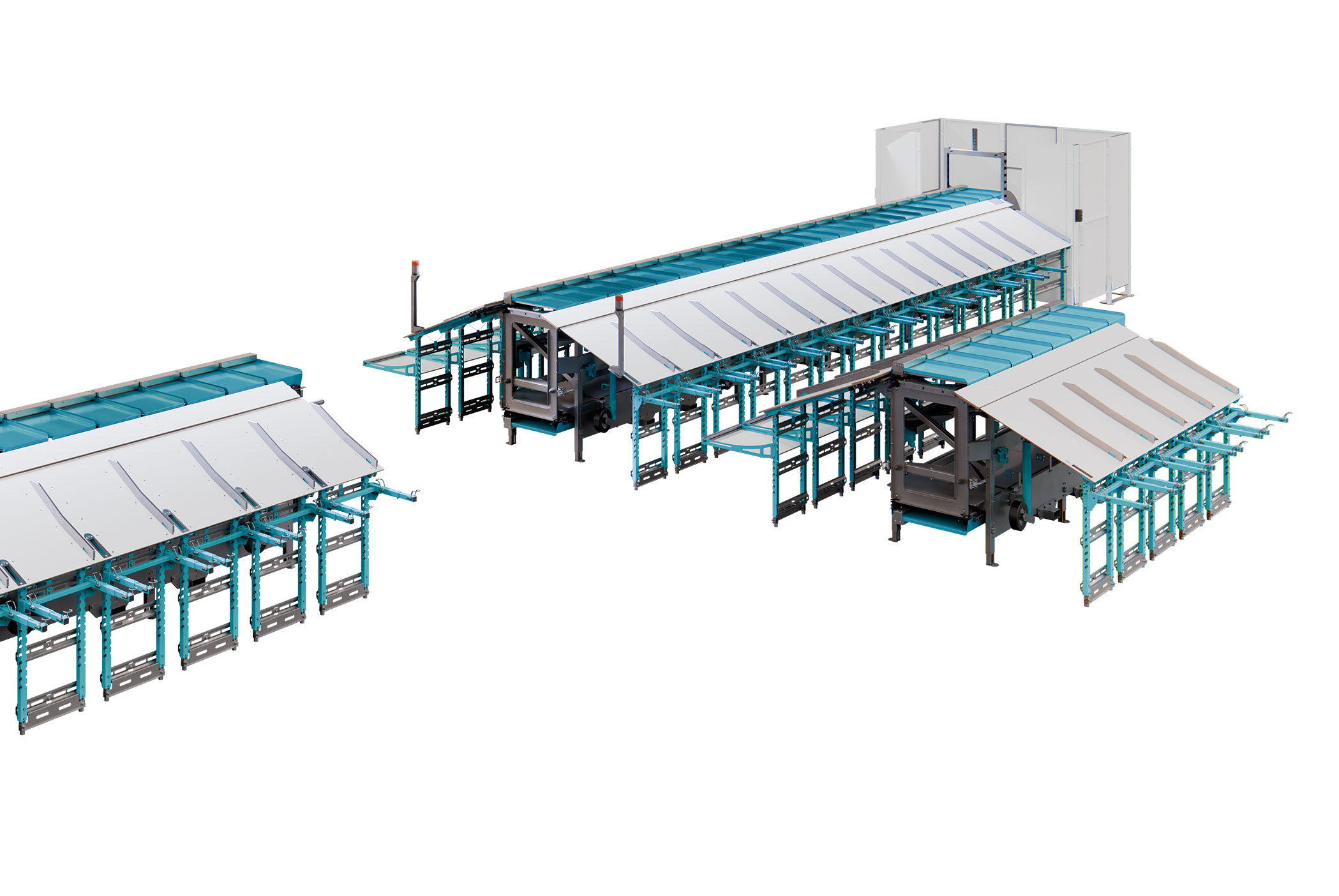
In parcel logistics, e-commerce fulfilment, retail distribution and last-mile operations, sorting requirements can change quickly. Volumes grow, product mixes shift, new routes are added, seasonal peaks become stronger, and warehouse layouts need to remain flexible.
The BOWE Modular Vertical Sorter MVS was designed exactly for this kind of dynamic environment. It is a compact, linear and fully modular sorting solution that allows companies to start with the capacity they need today — and expand later when operational requirements grow.
With its plug & play modular design, broad product handling capability and fast implementation concept, the MVS is an ideal solution for businesses that want to automate sorting while keeping investment risk low.
What is the Modular Vertical Sorter MVS?
The Modular Vertical Sorter, or MVS, is a flexible sorting system for small and medium-sized items such as parcels, cartons, polybags, flatpacks and similar products.
It uses proven push-tray technology to move items reliably and gently to the correct destination. Depending on the configuration, the system can be equipped with barcode scanning, weighing, dimensioning and different chute types.
The main advantage of the MVS is its modular design: customers can begin with a smaller configuration and expand the system later with additional modules, chutes and outputs.
See the MVS in action
The video gives a quick impression of how the Modular Vertical Sorter supports flexible automated sorting with a compact linear system design.
MVS at a glance
| Question | Fast answer |
|---|---|
| What does it sort? | Parcels, cartons, polybags, flatpacks and other small to medium items |
| Who is it for? | Parcel, e-commerce, retail, 3PL and last-mile logistics operations |
| Maximum item size | Up to 600 × 800 mm depending on configuration |
| Maximum item weight | Up to 15 kg |
| Maximum performance | Up to 10,000 items/trays per hour depending on configuration |
| Main advantage | Modular, scalable, movable and fast to implement |
| Integration | Can be connected to host systems, WMS/WCS and BOWE IQ software |
When is the MVS the right sorting solution?
The MVS is a strong option when your operation needs automated sorting, but your future requirements are still developing.
It is especially suitable if you:
- Need a sorting system for small to medium volumes
- Want to start with a lower investment and expand later
- Expect growing parcel or order volumes
- Need more destinations, chutes or sorting routes over time
- Process mixed product types such as cartons, polybags and flatpacks
- Have limited space and need a compact linear layout
- Want a system that can be relocated or extended with minimal downtime
- Need a fast project implementation compared to traditional sorter projects
For many logistics operations, the challenge is not only today’s volume. The real challenge is uncertainty: What will happen in six months, one year or three years? The MVS helps reduce this risk because the system can grow together with your business.
Key benefits of the Modular Vertical Sorter
1. Start small and expand later
With the MVS, you do not need to build the final system on day one. The modular concept allows you to start with the capacity and number of outputs you need now and add more modules when your operation grows.
This makes the MVS attractive for growing e-commerce operations, parcel networks, retail distribution centres and multi-client logistics environments.
2. Plug & play modularity
The MVS is designed around standardized modules. This enables fast installation, easier expansion and a more predictable project setup.
Additional modules can be integrated when more sorting destinations or higher capacity are required.
3. Lower investment risk
Traditional sorting projects often require a large initial investment and a fixed system layout. The MVS follows a different logic: invest in what you need today, while keeping the option to expand later.
This makes it easier to justify automation even when future volumes are not fully predictable.
4. Compact linear design
The linear design of the MVS makes it suitable for operations where available floor space is limited or where a simple and clear material flow is required.
The compact design also supports easier planning and integration into existing warehouse or sorting environments.
5. Broad product handling
The MVS is suitable for a wide range of small and medium items, including cartons, polybags, flatpacks, fashion items, cosmetics, electronics and pharmaceutical packaging.
The push-tray technology supports gentle and reliable handling of different product types.
6. Fast implementation
Because of its modular and preconfigured concept, the MVS is designed for fast project execution. This is especially relevant for customers who need additional sorting capacity quickly or want to react to increasing volumes without long implementation timelines.
7. Integration with automation and software
The MVS can be integrated into a wider intralogistics environment, including conveyor technology, host systems, warehouse management systems and BOWE IQ software solutions.
This allows the sorter to become part of a complete automation concept — from item identification and routing to tracking, reporting and process control.
How the MVS works
The sorting process is simple and efficient:
| 1 | Items are placed onto the infeed. |
| 2 | The item is identified by barcode scanning. |
| 3 | Optional weighing and dimensioning can be added depending on the configuration. |
| 4 | The item is assigned to the correct tray and destination. |
| 5 | The push-tray sorter transports the item through the system. |
| 6 | The item is discharged into the correct chute, bag, tote, carton holder or slide chute. |
This process allows automated sorting by destination, route, customer, order, store, delivery zone or any other logic defined in the customer’s host system or sorting software.
Technical data
| Specification | MVS 400 × 400 | MVS 500 × 700 |
|---|---|---|
| Tray size | 400 × 400 mm | 500 × 700 mm |
| Sorter capacity | Up to 10,000 trays/hour | Up to 8,000 trays/hour |
| Smallest parcel | 150 × 150 mm / 0.1 kg | 150 × 150 mm / 0.1 kg |
| Largest parcel | 350 × 350 mm / 15 kg | 450 × 650 mm / 15 kg |
| Larger parcel option | — | 600 × 800 mm possible on 2 trays |
| Configuration | Min. 2 modules / max. 16 modules | Min. 2 modules / max. 16 modules |
| Required facilities | 380V, 32A, Ethernet, host connection | 380V, 32A, Ethernet, host connection |
Actual system performance depends on the item profile, infeed concept, barcode quality, scanning rate, operator process, layout, chute configuration and integration concept.
BOWE Austria can help evaluate the right configuration based on your real operational data.
Infeed and scanning options
Depending on the project requirements, the MVS can be configured with different infeed concepts.
Available options include:
- Compact infeed with barcode scanning
- 3-side or 5-side scanning
- Optional weighing
- Optional dimensioning
- Legal for Trade readiness depending on configuration
- Virtual tray belt or perfect pitch infeed concept
The right infeed concept depends on the required throughput, product mix, scanning quality and operator process.
For larger items, such as 600 × 800 mm parcels on two trays, the perfect pitch concept can help improve handling efficiency and sorting performance.
Chute configurations
The MVS supports different chute types, depending on the customer’s process and destination handling concept.
Typical chute options include:
- Tote or carton holder
- Bag holder
- Slide chute
- Mixed chute configurations
This flexibility makes it possible to adapt the sorter to different operational models, such as parcel sorting, store replenishment, e-commerce order consolidation or route-based sorting.
MVS applications by industry
The Modular Vertical Sorter can be adapted to different logistics environments — from e-commerce fulfilment and parcel operations to retail distribution and multi-client logistics.
E-commerce fulfilment
For operations with changing order volumes, seasonal peaks and flexible carrier structures.
- Carrier sorting
- Order consolidation
- Delivery zone sorting
- Peak season handling
Parcel & last-mile logistics
For parcel hubs, depots and last-mile networks that need fast and reliable destination sorting.
- Route sorting
- Depot sorting
- Postcode sorting
- Courier destination handling
Retail distribution
For distribution centres that sort goods by store, region, route, product group or order.
- Store distribution
- Carton sorting
- Replenishment sorting
- Returns handling
In each application, the sorting logic can be defined according to the customer’s process — for example by carrier, route, store, delivery area, order or destination.
MVS compared with traditional sorter projects
Many traditional sorter projects are designed for a fixed target layout and a fixed capacity scenario. This can be difficult when the business is growing or when future demand is uncertain.
The MVS offers a more flexible approach.
Instead of overinvesting in a large system from the beginning, customers can start with a smaller sorter and expand it later. This reduces investment risk and allows the automation concept to follow the real development of the business.
For companies with dynamic logistics requirements, this modularity can be a decisive advantage.
What data is needed to design the right MVS configuration?
To evaluate the right sorting concept, it is useful to analyse the real operational data behind the process. The more complete the input data is, the more precisely the sorter size, number of modules, chute concept, infeed configuration and integration approach can be defined.
Typical project input data:
| Data area | Information needed |
|---|---|
| Volume & performance | Current parcel or item volume, expected future volume, peak volume per hour |
| Destinations & sorting logic | Number of destinations, sorting routes, stores, delivery zones or customer-specific sorting logic |
| Item profile | Item dimensions and weight range, product types, packaging types, special handling requirements |
| Identification & scanning | Barcode position, barcode quality, required scanning concept, optional weighing or dimensioning requirements |
| Layout & infrastructure | Available floor space, existing conveyor or warehouse infrastructure, possible infeed and discharge areas |
| IT & integration | WMS, ERP or host system requirements, interface logic, data exchange and reporting needs |
| Timeline & future growth | Target go-live date, future expansion plans, expected changes in volume, destinations or product mix |
Based on this information, BOWE Austria can help define the right MVS configuration for the customer’s real operational requirements.
Frequently asked questions about the MVS
What is a Modular Vertical Sorter?
A Modular Vertical Sorter is a flexible sorting system that can be expanded with additional modules. It is designed to automate sorting processes while allowing companies to adapt the system to future growth.
Which products can the MVS sort?
The MVS can sort small and medium-sized items such as cartons, parcels, polybags, flatpacks, fashion items, cosmetics, electronics and pharmaceutical packaging.
What is the maximum item size?
Depending on the configuration, the MVS can handle items up to 600 × 800 mm.
What is the maximum item weight?
The maximum item weight is up to 15 kg, depending on the configuration and product profile.
How many items per hour can the MVS sort?
The MVS can reach up to 10,000 items or trays per hour depending on the tray size, infeed concept, item profile and system configuration.
Can the MVS be expanded later?
Yes. The MVS is designed as a modular system. Additional modules, chutes and outputs can be added when capacity requirements grow.
Can the MVS be relocated?
Yes. The MVS is designed to be scalable and movable, making it suitable for operations where layouts or capacity requirements may change over time.
Can the MVS be connected to our WMS or ERP system?
Yes. The MVS can be integrated with host systems, WMS/WCS environments and BOWE IQ software solutions.
Does the MVS support weighing and dimensioning?
Yes. Depending on the selected infeed configuration, weighing and dimensioning can be integrated.
Is the MVS suitable for e-commerce?
Yes. The MVS is well suited for e-commerce fulfilment operations that need flexible sorting by carrier, route, destination, order or delivery zone.
Is the MVS suitable for parcel and last-mile logistics?
Yes. The MVS is suitable for parcel, courier and last-mile operations that require reliable sorting and the flexibility to expand capacity over time.
How do I know if the MVS is right for my operation?
The best way is to analyse your item profile, peak volume, number of destinations, available space and integration requirements. BOWE Austria can support this evaluation and recommend the right configuration.
BOWE Austria: your local partner for sorting automation
BOWE Austria supports customers in Austria and Central/Eastern Europe with intralogistics automation solutions that combine engineering, software, system integration and service support.
Our team helps you evaluate your sorting process, define the right automation concept and integrate the solution into your existing operation.
With the Modular Vertical Sorter, BOWE Austria offers a flexible sorting solution for companies that want to automate today while staying ready for tomorrow’s growth.
Do you want to know if the MVS fits your operation?
Send us your item profile, target throughput, number of destinations and available space.
The BOWE Austria team will help you evaluate the right MVS configuration for your sorting process.